Finnovó

Designing a Decision System for Financial Avoidance

The Core Problem~

Users didn’t abandon finance apps because of complexity — they avoided them because each interaction forced emotionally loaded decisions.

Finnovó explores how restructuring when and how decisions appear can reduce avoidance under cognitive load.

Impact & Outcomes

(Exploratory)

~

• Improved clarity around spending boundaries

• Increased user confidence in AI-assisted guidance

• Reduced perceived decision fatigue during budgeting

Role Scope Constraints

• Sole UX Researcher & Product Designer

• 4-week exploratory system design

• *conceptual, mobile-first

Focus

• Human–AI decision logic · Cognitive load

• Trust & failure states · System constraints

This is a UX-led system design artifact — not a UI showcase.

Finnovó explores how AI-assisted systems can reduce decision fatigue and guide financial behavior — while preserving user control and trust.

Finnovó

Designing a Decision System for Financial Avoidance

The Core Problem~

Users didn’t abandon finance apps because of complexity -they avoided them because each interaction forced emotionally loaded decisions.

Finnovó explores how restructuring when and how decisions appear can reduce avoidance under cognitive load.

Impact & Outcomes

(Exploratory)

~

• Improved clarity around spending boundaries

• Increased user confidence in AI-assisted guidance

• Reduced perceived decision fatigue during budgeting

Role Scope Constraints

• Sole UX Researcher & Product Designer

• 4-week exploratory system design

• *conceptual, mobile-first

Focus

• Human–AI decision logic · Cognitive load

• Trust & failure states · System constraints

This is a UX-led system design artifact — not a UI showcase.

Finnovó explores how AI-assisted systems can reduce decision fatigue and guide financial behavior — while preserving user control and trust.

Role Scope Constraints

•Sole UX Researcher & Product Designer

•4-week exploratory system design

•*conceptual, mobile-first

Focus

•Human–AI decision logic · Cognitive load

•Trust & failure states · System constraints

This is a UX-led system design artifact - not a UI showcase.

Finnovó explores how AI-assisted systems can reduce decision fatigue and guide financial behavior — while preserving user control and trust.

Why Most Finance Apps Fail at Decision-Making

Why Most Finance Apps Fail at Decision-Making

Most personal finance tools are designed around a flawed assumption:

If users are given enough data, they will make better financial decisions.

In practice, the opposite consistently happens.

In practice, the opposite consistently happens.

Modern finance apps require users to continuously manage:

• Constant balances, charts & categories

always-on financial awareness

• Multiple competing recommendations

conflicting guidance

• Manual rules, alerts, and thresholds

configuration responsibility

• Long-term goals — short-term trade-offs

unresolved tension

Instead of enabling clarity, these systems increase cognitive load and shift responsibility entirely onto the user.

A typical finance UX failure loop:
choice overload → emotional pressure → avoidance → abandonment

The result is not lack of discipline — but decision fatigue.

The result is not lack of discipline

- but decision fatigue.

The Core Misalignment

The Core Misalignment

Through secondary research and competitive analysis, a consistent pattern emerged:

Finance products tend to optimize for:

While users actually need:

• Visibility (more insights, more metrics)

•Visibility (more insights, more metrics)

Fewer, better-timed decisions

• Control (manual categorization, adjustable rules)

•Control (manual categorization, adjustable rules)

Clear boundaries instead of constant choice

• Engagement (frequent prompts and nudges)

•Engagement (frequent prompts and nudges)

Guidance that reduces mental effort, not adds to it

This misalignment leads users to disengage — not because they don’t care about money,
but because the system demands too much cognitive work.

Reframing the Problem

Reframing the Problem

The problem is not budgeting.

The problem is not budgeting.

The problem is decision design.

The problem is decision design.

*The real question becomes:

*The real question becomes:

" How might an AI-assisted system help users make fewer, better financial decisions
— without removing their sense of agency? "

" How might an AI-assisted system help users make fewer, better financial decisions
- without removing their sense of agency? "

This reframing shifts the design goal from:

This reframing shifts the design goal from:

Building a finance app

Designing a decision-support system

Design Implication

Design Implication

This insight set the foundation for Finnovó:

• The system should absorb complexity, not expose it

  • he system should absorb complexity, not expose it

• Decisions should be timed and contextual, not constant

  • Decisions should be timed and contextual, not constant

• AI should act as a supportive layer, not an authority

  • AI should act as a supportive layer, not an authority

Only after redefining the problem this way did interface design become meaningful

Common False Assumptions in Finance Products

Common False Assumptions in Finance Products

Assumption #1

Assumption #1

"More data leads to better decisions"

Reality:

Reality:

More data increases interpretation cost, not clarity.

Breaks when:

Breaks when:

• Options multiply

  • Options multiply

• Context switching increases

  • Context switching increases

• Uncertainty remains unresolved

  • Uncertainty remains unresolved

📌

Failure mode:

Failure mode:

Decision paralysis

Assumption #2

Assumption #2

“Users want full control at all times”

Reality:

Reality:

Users want guardrails, not micromanagement.

What users actually prefer:

• Defaults they can trust

  • Defaults they can trust

• The option to intervene

  • The option to intervene

• Not having to decide constantly

  • Not having to decide constantly

📌

Failure mode:

Failure mode:

Control fatigue

Assumption #3

Assumption #3

“Automation is either trusted or rejected”

Reality:

Reality:

Trust is conditional and progressive.

Users trust automation when they understand:

• Why a suggestion exists

  • Why a suggestion exists

• What assumptions power it

  • What assumptions power it

• What happens if it’s wrong

  • What happens if it’s wrong

📌

Failure mode:

Failure mode:

Blind automation → distrust

ASSUMPTION → REALITY → FAILURE MODE

Blind automation reduces trust.

Transparent, reversible automation builds it.

System Constraints That Shaped Finnovó

System Constraints That Shaped Finnovó

Designing Guardrails, Not Just Features

Designing Guardrails, Not Just Features

1. Reduce Decisions, Not Information Accuracy

1. Reduce Decisions, Not Information Accuracy

Constraint:

The system cannot surface information unless it removes a decision.

The system cannot surface information unless it removes a decision.

Design consequence:

Raw financial data is aggregated & delayed until it becomes decision-critical.

Raw financial data is aggregated & delayed until it becomes decision-critical.

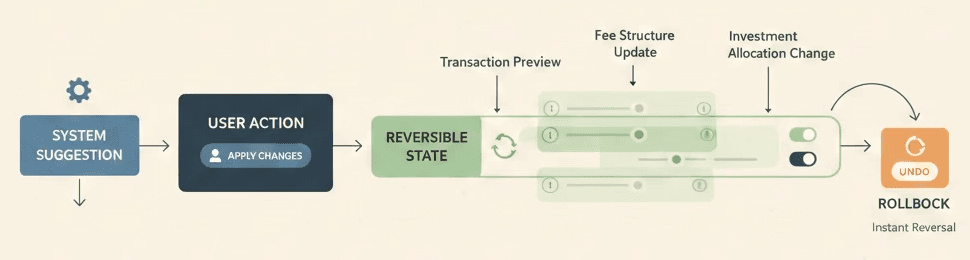
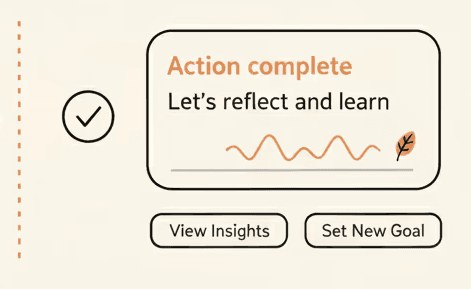
2. Preserve Agency Through Reversibility

2. Preserve Agency Through Reversibility

Constraint:

No system action is final without user intent.

No system action is final without user intent.

Design consequence:

All AI guidance is explainable, adjustable & reversible.

All AI guidance is explainable, adjustable & reversible.

3. Default to Boundaries, Not Optimization

3. Default to Boundaries, Not Optimization

Constraint:

The system does not optimize for “more” or “less.”

The system does not optimize for “more” or “less.”

Design consequence:

Users are shown safe, risky & forbidden ranges instead of goals.

Users are shown safe, risky & forbidden ranges instead of goals.

4. Design for Cognitive Load, Not Engagement

4. Design for Cognitive Load, Not Engagement

Constraint:

Success is not measured by frequency of interaction.

Success is not measured by frequency of interaction.

Design consequence:

The system minimizes interruptions & surfaces only decision-critical moments.

The system minimizes interruptions & surfaces only decision-critical moments.

Outcome:

Outcome:

Trust increased not through engagement, but through predictability and reversibility.

Trust increased not through engagement, but through predictability and reversibility.

What the System Explicitly Refuses to Do

What the System Explicitly Refuses to Do

Defining constraints was equally important.

• Manual categorization

• Competing recommendations

• Constant budget micromanagement

• Assumed financial literacy

These exclusions prevented the system from slipping back into UI-heavy, control-heavy patterns.

These exclusions prevented the system from slipping back into UI-heavy, control-heavy patterns.

What We Explicitly Did Not Optimize For

What We Explicitly Did Not Optimize For

Trade-Offs & Constraint

Trade-Offs & Constraint

Why it mattered

Why it mattered

Decision

Decision

Fully Autonomous Actions

Fully Autonomous Actions

AI never executes financial actions without user confirmation

Preserved trust & user agency

Exhaustive Financial Dashboards

Exhaustive Financial Dashboards

No raw data walls by default — only decision-ready summaries

Reduced cognitive load

Punitive Alerts & Guilt Loops

Punitive Alerts & Guilt Loops

Contextual, non-judgmental nudges only

Higher emotional safety & re-engagement

Engagement-Driven Design

Engagement-Driven Design

System stays quiet unless intervention is meaningful

Quiet reliability over attention capture

These constraints enabled predictable AI behavior, clear financial boundaries, and trust built through restraint rather than intelligence.

These constraints enabled predictable AI behavior, clear financial boundaries, and trust built through restraint rather than intelligence.

Why a Decision Loop Was Necessary

Why a Decision Loop Was Necessary

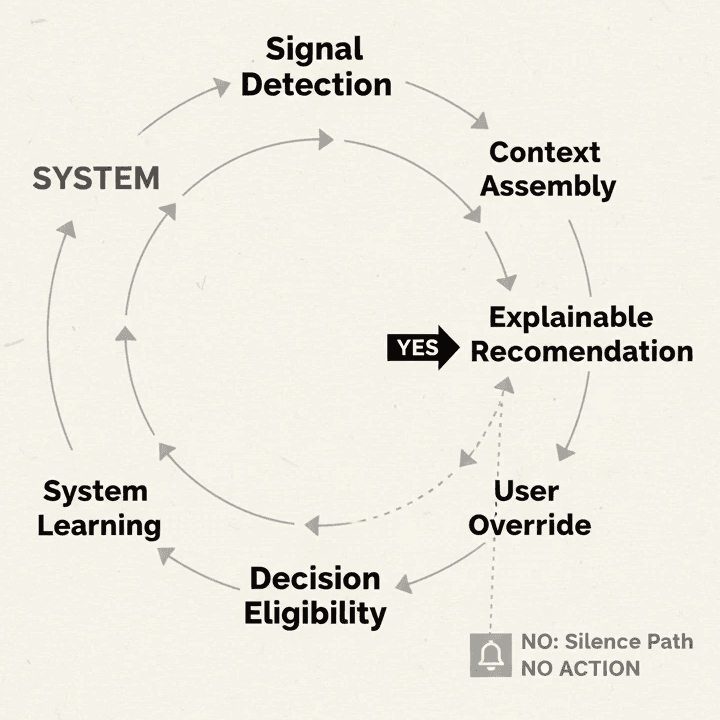
In most finance apps, automation operates invisibly — recommendations appear without clear triggers, assumptions, or failure handling.

Finnovó treats AI not as a prediction engine, but as a decision mediator operating within strict system constraints.

A Constrained, Interpretable Decision Cycle

Every system action in Finnovó passes through the same loop.

The system cannot suggest, intervene, or alert unless all stages are satisfied.

Behavior

Signal

Suggestion

User Control

Feedback

Signal Detection

The system monitors financial signals passively without surfacing them.

The system monitors financial signals passively without surfacing them.

Spending drift, Boundary proximity, Pattern deviation

Context Assembly

Signals are evaluated within user-defined boundaries, historical behavior, and risk tolerance.

Signals are evaluated within user-defined boundaries, historical behavior, and risk tolerance.

No signal is evaluated in isolation.

No signal is evaluated in isolation.

Decision Eligibility Check

The system asks: Does acting now remove a meaningful decision for the user?

The system asks: Does acting now remove a meaningful decision for the user?

If nosystem stays silent.

If yescontinue.

Explainable Recommendation

Explainable Recommendation

When a suggestion is surfaced, the system exposes:

When a suggestion is surfaced, the system exposes:

• Why now

• Why now

• What assumptions were used

• What assumptions were used

• What outcome is expected

• What outcome is expected

No black-box actions.

No black-box actions.

User Override & Reversibility

User Override & Reversibility

Users can adjust, delay, or reject any suggestion without penalty.

Users can adjust, delay, or reject any suggestion without penalty.

Rejection is treated as signal, not failure.

Rejection is treated as signal, not failure.

System Learning (Non-Authoritative)

System Learning (Non-Authoritative)

The system adapts boundaries and timing — not user intent.

The system adapts boundaries and timing — not user intent.

Finnovó does not “optimize behavior”; it optimizes decision timing.

Finnovó does not “optimize behavior”; it optimizes decision timing.

Finnovó treats AI as a collaborator in decision-making — not an invisible operator.

Finnovó treats AI as a collaborator in decision-making — not an invisible operator.

What Happens When the System Is Wrong

What Happens When the System Is Wrong

Finnovó assumes uncertainty by default.

Finnovó assumes uncertainty by default.

• No action is irreversible

• No action is irreversible

• Ambiguous situations default to silence

• Ambiguous situations default to silence

• Users can inspect and rewind past system decisions

• Users can inspect and rewind past system decisions

Why This Loop Matters

By constraining when AI can act — and exposing how it reasons — Finnovó reduces cognitive load without removing agency.

By constraining when AI can act — & exposing how it reasons — Finnovó reduces cognitive load without removing agency.

The system earns trust through predictability, not persuasion.

Trust is preserved not by correctness — but by recoverability.

Trust is preserved not by correctness

- but by recoverability.

Key Decision Moments

Key Decision Moments

Intervention vs Silence

Before a Spending Decision

Before a Spending Decision

User is about to spend, but hasn’t crossed a limit yet

User is about to spend, but hasn’t crossed a limit yet

System Behavior:

• Detects proximity to a budget boundary

• Detects proximity to a budget boundary

• Surfaces a subtle, dismissible nudge

• Surfaces a subtle, dismissible nudge

• No blocking, no alerts, no urgency

• No blocking, no alerts, no urgency

Prevents regret without blocking intent

After an Overspend

After an Overspend

User exceeds a budget boundary.

System Behavior:

• No alerts. No penalties.

• No alerts. No penalties.

• Post-action reflection shown later

• Post-action reflection shown later

• System recalibrates future guidance

• System recalibrates future guidance

Reduces shame and encourages recovery

Pattern-Level Risk (Not Single Events)

Pattern-Level Risk (Not Single Events)

Repeated small deviations across time.

System Behavior:

• Detects behavioral drift

• Detects behavioral drift

• Surfaces a pattern insight, not a warning

• Surfaces a pattern insight, not a warning

• User decides whether to act

• User decides whether to act

Shifts focus from events to habits

When the User Disagrees with AI

When the User Disagrees with AI

User chooses to override a recommendation.

User chooses to override a recommendation.

System Behavior:

• Override allowed instantly

• Override allowed instantly

• Rationale shown, not enforced

• Rationale shown, not enforced

• No corrective pushback

• No corrective pushback

Preserves user agency; AI remains an advisor

Preserves user agency;
AI remains an advisor

Principle Behind All Interventions

Principle Behind All Interventions

Intervene only when the system can reduce cognitive load —
stay silent when intervention adds none.

Failure Was the Design Constraint

Failure Was the Design Constraint

Failure was not treated as an exception.

It was assumed, expected, and designed for.

Silence Tolerance

Silence Tolerance

System remains unused but not abandoned

System remains unused but not abandoned

(no uninstall, no opt-out)

Quiet reliability

Finnovó does not attempt to prevent financial mistakes in real time.

Finnovó does not attempt to prevent financial mistakes in real time. It focuses on recoverability, reflection & trust continuity.

It focuses on recoverability, reflection, and trust continuity.

Primary Failure: Budget Breach (Overspending)

Overspending is the most common and most emotionally charged failure.

System response

• No alerts

  • No alerts

• No warnings

  • No warnings

• No intervention mid-action

  • No intervention mid-action

The system waits until after the decision, then reframes it.

Why

• Prevents shame-driven abandonment

  • Prevents shame-driven abandonment

• Preserves user autonomy

  • Preserves user autonomy

• Keeps trust intact even when goals are missed

  • Keeps trust intact even when goals are missed

Failure is absorbed — not punished.

Secondary Failures: When Users Disagree or Disengage

These are not treated as errors. They are treated as signals.

• Ignored recommendation → system adapts quietly

  • Ignored recommendation

    → system adapts quietly

• User override → disagreement becomes learning input

  • User override

    → disagreement becomes learning input

• Repeated deviation → patterns surfaced, not mistakes highlighted

  • Repeated deviation

    → patterns surfaced, not mistakes highlighted

The system listens more than it corrects.

Recovery Over Prevention

Finnovó optimizes for:

• Reversibility without penalty

  • Reversibility without penalty

• Predictable behavior over enforcement

  • Predictable behavior over enforcement

• Long-term trust over short-term compliance

  • Long-term trust over short-term compliance

Users are never forced back “on track.” They are invited to understand their own patterns.

Trust Model

Trust Model

Trust is not built by being right.

It is built by being predictable when things go wrong.

Finnovó remains consistent — even when users don’t.

Design Principle

Design Principle

Failure is the primary use case.

If the system works when users fail, it will work when they succeed.

Why This Matters

This approach reduces:

• Financial anxiety

• Financial anxiety

• Drop-off after mistakes

• Drop-off after mistakes

• Defensive or avoidance behavior

• Defensive or avoidance behavior

And increases:

• Honest engagement

• Long-term retention

• Self-directed improvement

Failure is absorbed — not punished.

And increases:

• Honest engagement

• Long-term retention

• Self-directed improvement

Failure is absorbed — not punished.

Outcome

Finnovó becomes:

• A system users return to after mistakes

• Not a system they avoid because of them

Interface as Consequence (UI)

Interface as Consequence (UI)

The interface was treated as a consequence of system behavior — not a surface for features.

The interface was treated as a consequence of system behavior — not a surface for features.

User Journey Map

User Journey Map

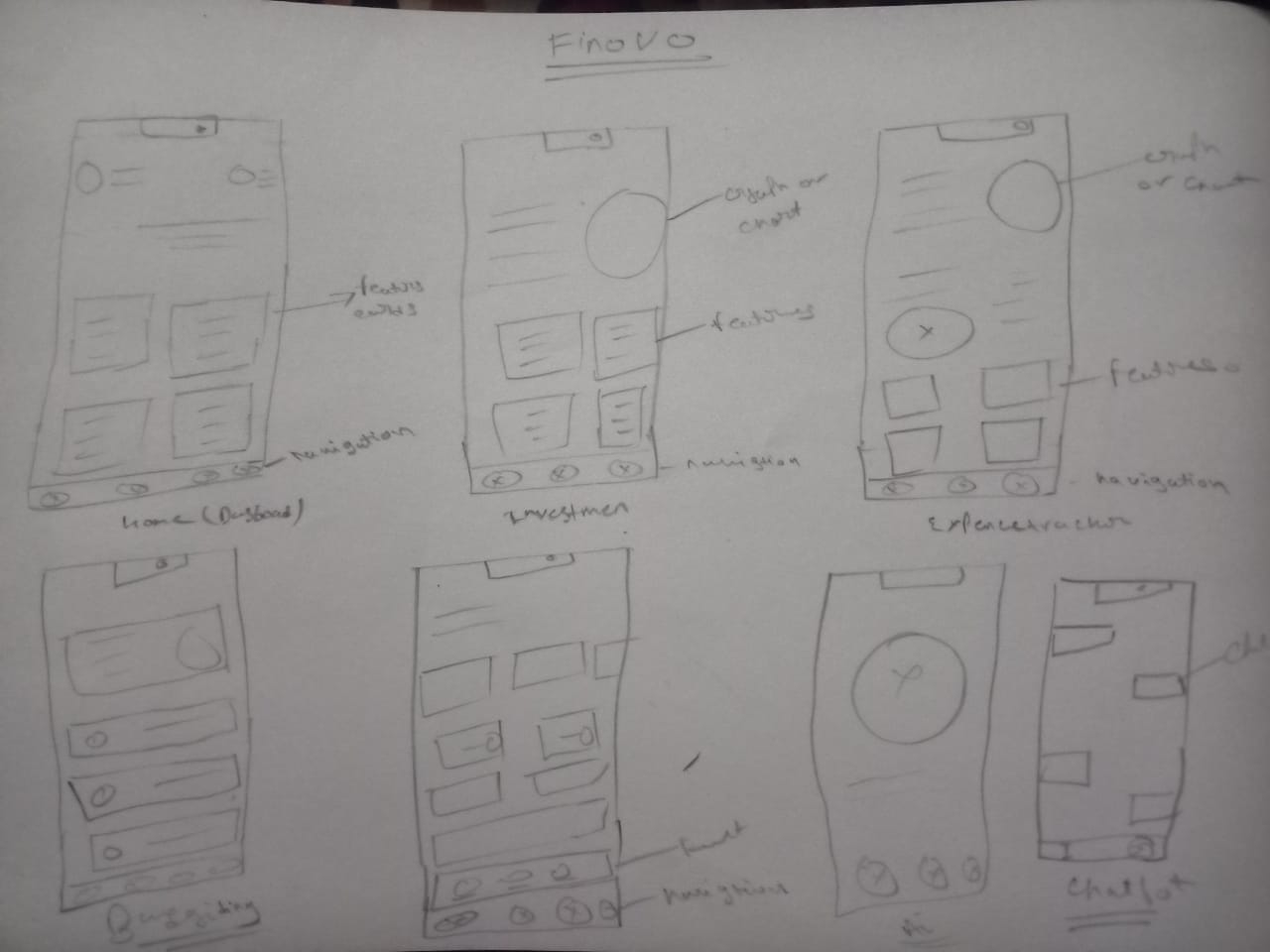
Early sketches focused on placement of decision moments, not visual style.

From Decision Logic → Information Architecture

From Decision Logic → Information Architecture

• Home

• Home

Decision awareness

Decision awareness

• Expenses

• Expenses

Behavior visibility

Behavior visibility

• Budgeting

• Budgeting

Boundary definition

Boundary definition

• Statistics

• Statistics

Reflection, not control

Reflection, not control

• AI Modeling

• AI Modeling

Explanation & adjustment

Explanation & adjustment

Each surface exists to support a specific cognitive state — not a task list.

user flows

Each flow was designed to end cleanly — without looping the user back into the system.

Pen-and-paper sketches

Early sketches focused on placement of decision moments, not visual style.

Low-fi greyscale wireframes

Visual hierarchy was tested before color, motion, or branding.
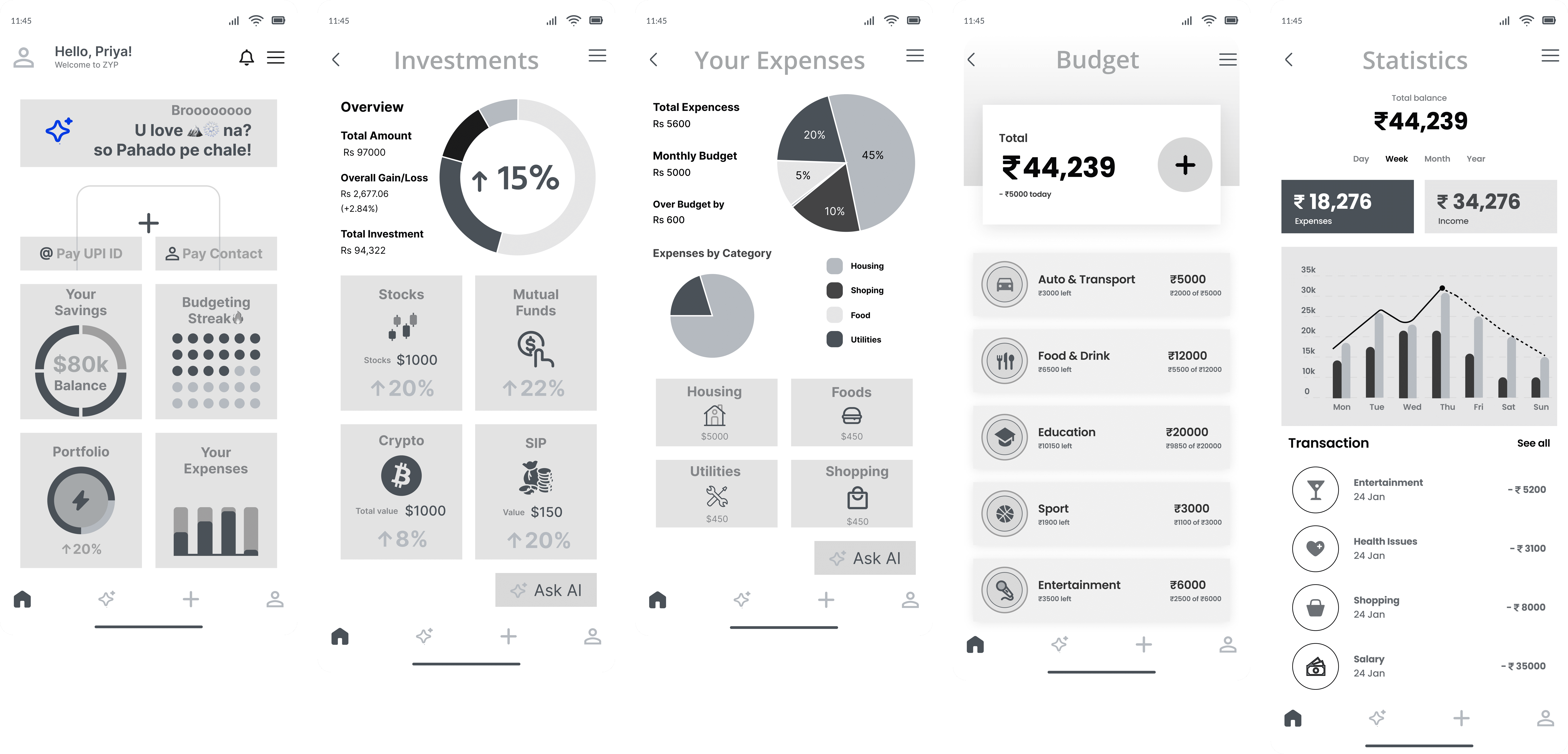
Why the Interface Looks Quiet

Why the Interface Looks Quiet

Visual quietness was a functional decision, not an aesthetic one.

High-contrast interfaces create urgency.

Urgency increases decision pressure.

Decision pressure was the problem being designed against.

Decision pressure was the problem being designed against.

The interface intentionally:

• Limits color usage to boundary states

  • Limits color usage to boundary states

• Avoids high-saturation success or failure signals

  • Avoids high-saturation success or failure signals

• Maintains consistent visual hierarchy across screens

  • Maintains consistent visual hierarchy across screens

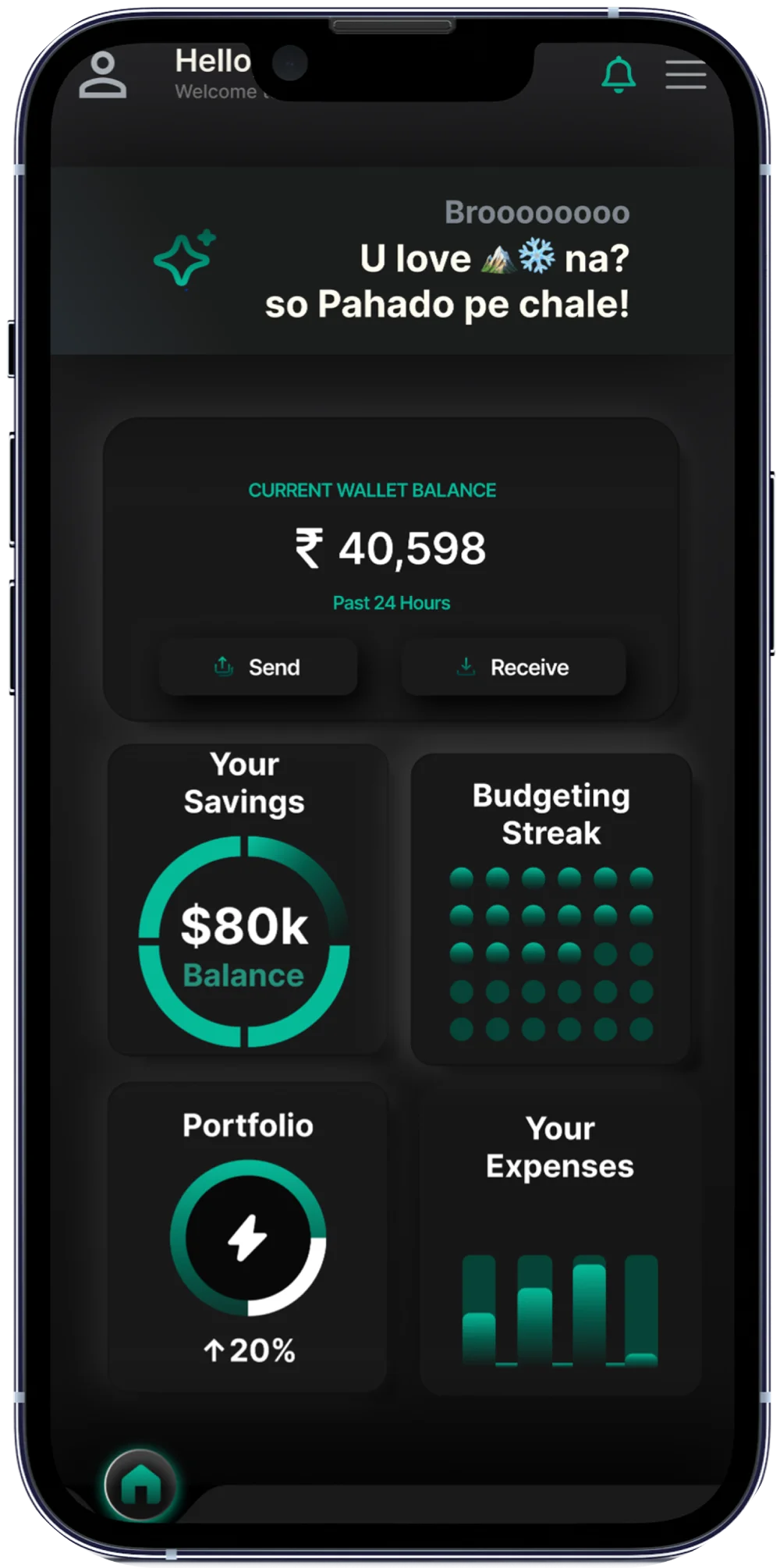
Even in dark mode, contrast was restrained to prevent visual dominance from becoming emotional pressure.

*Dark mode shown for consistency; system supports light surfaces in production

Screens as Decision Moments (Not Feature Tours)

Screens as Decision Moments (Not Feature Tours)

The interface was treated as a consequence of system behavior — not a surface for features.
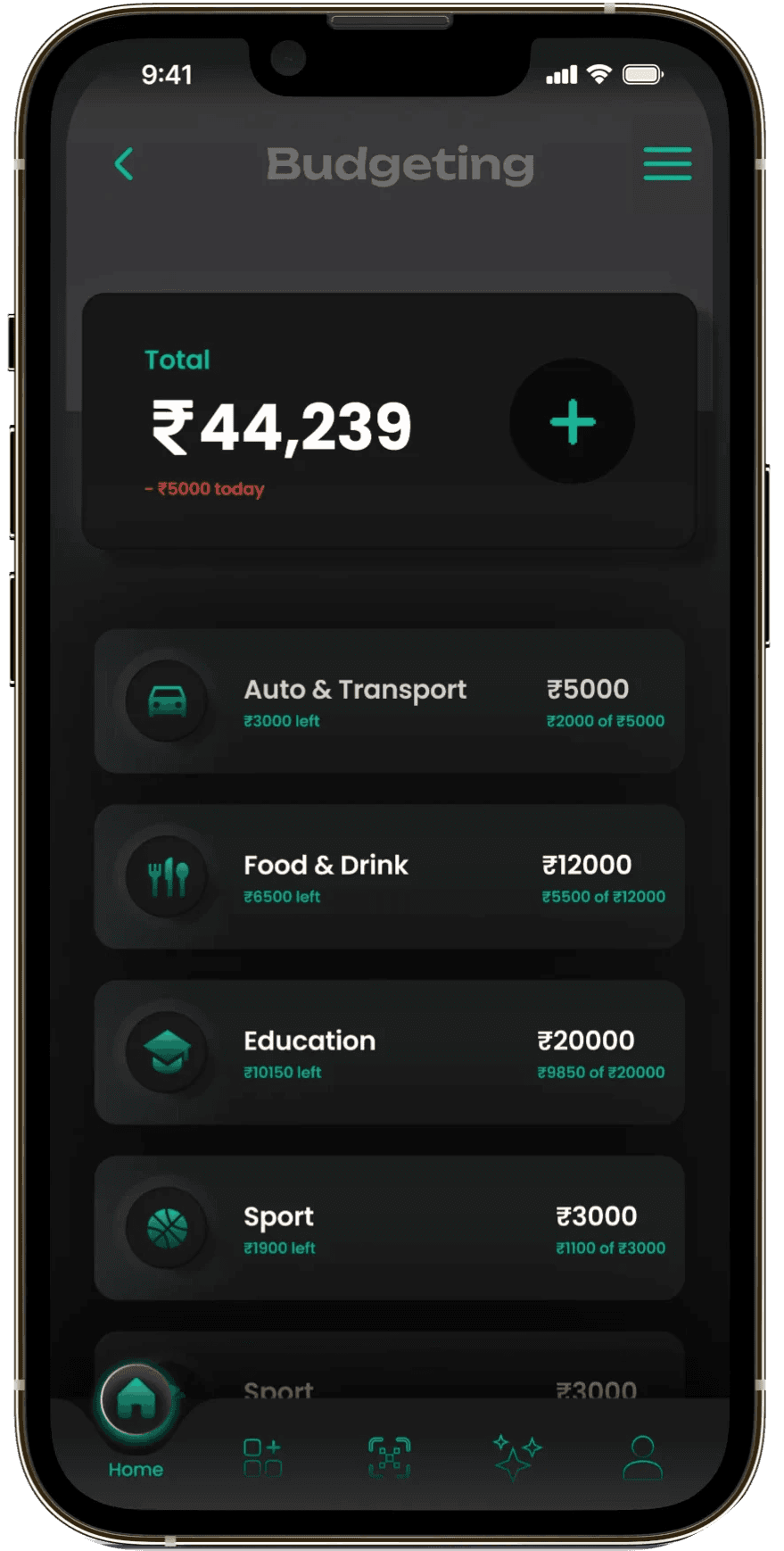
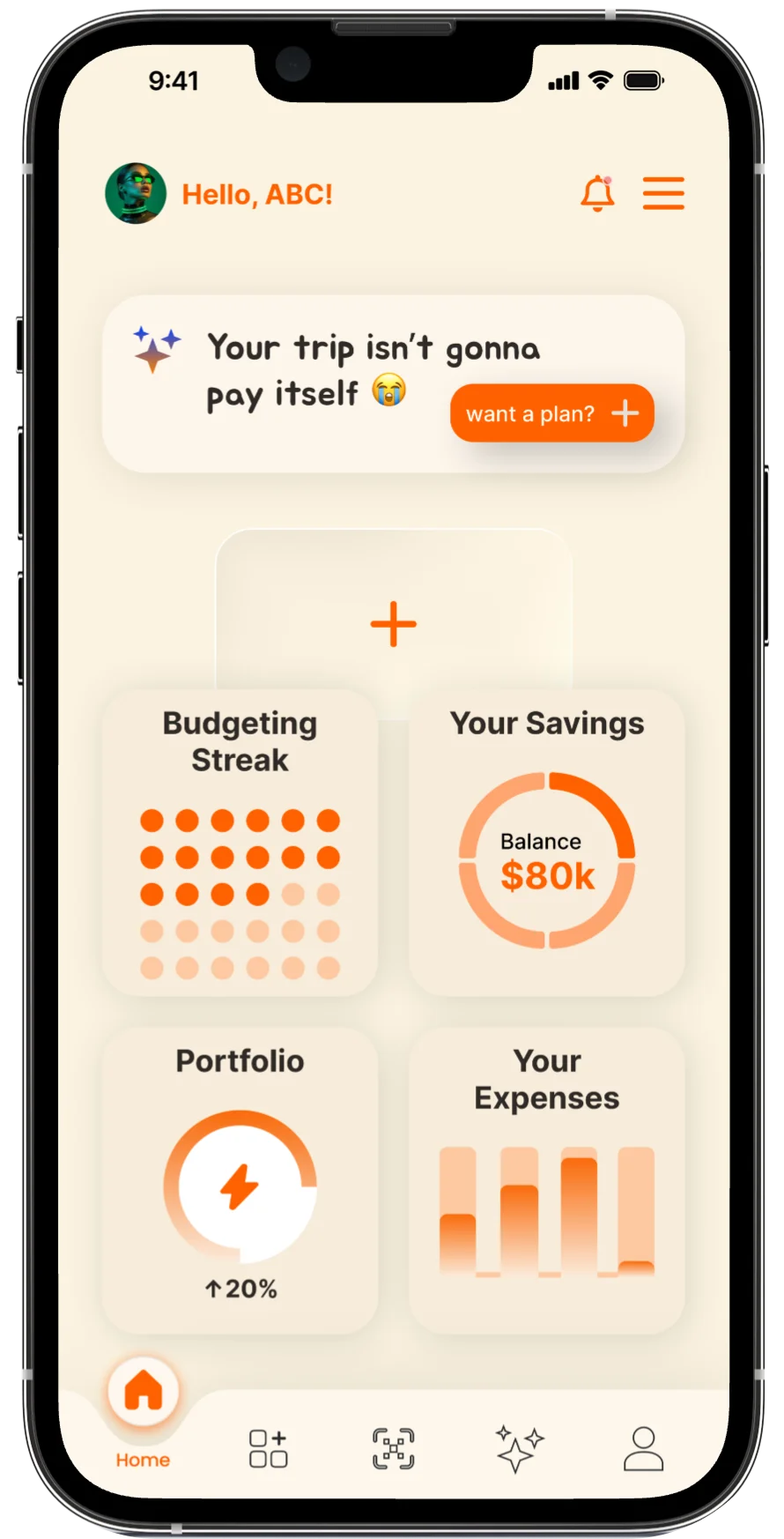
Home — Decision Awareness, Not Control

The home screen exists to prepare decisions — not demand them.

System context

• Detects behavioral drift

• Tracks proximity to boundaries

• Knows timing sensitivity

Intentionally hidden

• Transaction noise

• Predictive certainty

• “You should” language

Interface response

• Calm summary, no urgency

• Optional, dismissible nudge

• No raw data surfaces by default

Budget — Boundaries Over Goals

Budgeting was treated as boundary-setting, not self-discipline training.

System context

• Knows safe, risky, and forbidden ranges

• Detects slow drift, not single mistakes

Intentionally hidden

• Perfection metrics

• Optimization prompts

• Gamified streak pressure

Interface response

• Range-based budgets instead of targets

• Sliders emphasize reversibility

• No red states, no “failure” screens

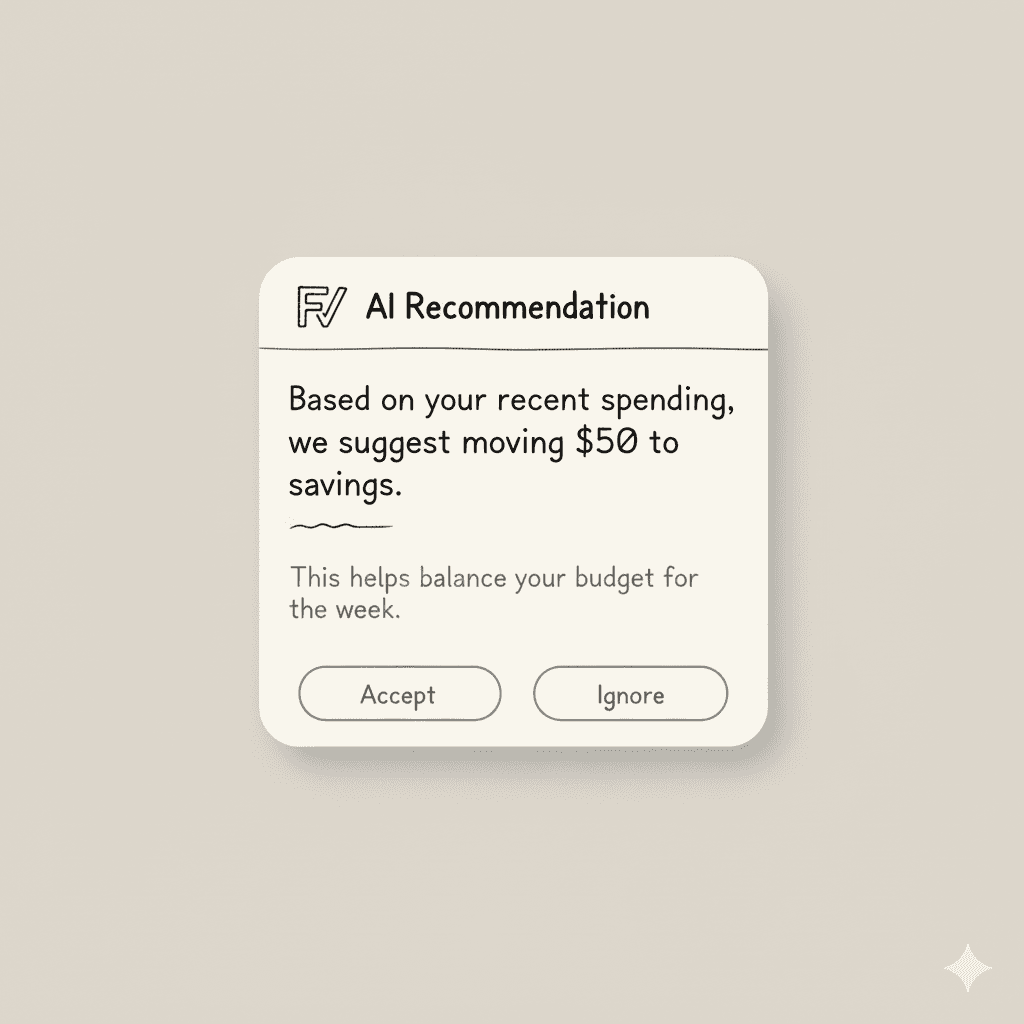
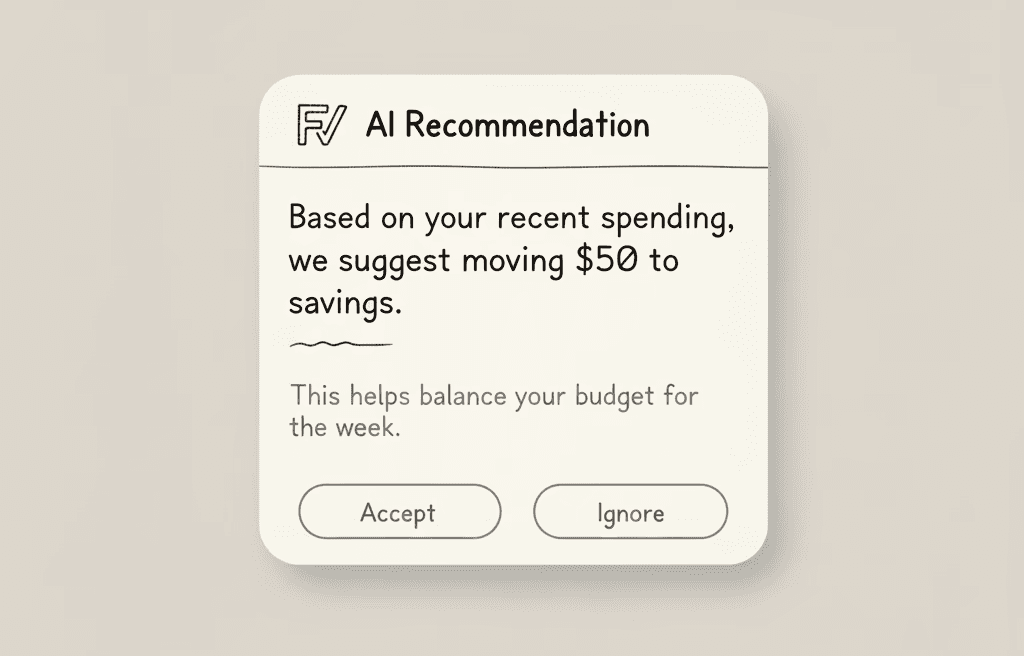
AI Recommendation — Advisory, Not Authority

Budgeting was treated as boundary-setting, not self-discipline training.

System context

• Confidence-weighted signals

• Known uncertainty

Intentionally hidden

• Confidence theatrics

• Corrective language

• Escalation paths

Interface response

• Accept / Ignore / Adjust always visible

• Explanation available, not forced

• Overrides have no penalty

The system never escalates disagreement into friction.

Security & Trust

Security & Trust

Protection without intimidation

Financial security shouldn’t interrupt flow or amplify anxiety. Finnovo’s security system is designed to protect users quietly, predictably, and only when risk meaningfully increases.

Progressive security

Security appears only when risk increases, not by default.

Security appears only when risk increases, not by default.

Friction proportional to risk

Stronger checks for higher-impact actions, not everyday usage.

Stronger checks for higher-impact actions, not everyday usage.

Clarity over alarm

Alerts explain what happened and what to do — without fear-based language.

Alerts explain what happened and what to do — without fear-based language.

Biometric Login

Two-Factor Authentication (2FA)

Device Security + Password Manager

Data Encryption

01

Biometric Login

Enables instant, password-free login using Face ID or fingerprint authentication.

Prevents unauthorized access without disrupting everyday usage

Respects user flow while protecting critical moments

Avoids constant security fatigue

Biometric authentication is device-dependent and supplemented by fallback security for sensitive actions.

This security system was designed and validated through simulated flows and UX reasoning, prioritizing emotional safety and trust — not performance metrics or financial outcomes.

This security system was designed & validated through simulated flows and UX reasoning, prioritizing emotional safety & trust — not performance metrics or financial outcomes.

DECISION PRESSURE REDUCTION LOOP

User-Level Outcomes (NOT metrics-first)

User-Level Outcomes (NOT metrics-first)

Observed shifts in user behavior:

• Users delayed fewer purchases impulsively after boundary nudges

  • Users delayed fewer purchases impulsively after boundary nudges

• Overspending moments did not lead to disengagement or shame-driven churn

  • Overspending moments did not lead to disengagement or shame-driven churn

• Users overrode AI suggestions without abandoning trust in the system

  • Users overrode AI suggestions without abandoning trust in the system

What mattered:

The system reduced decision pressure, not financial mistakes.

System-Level Outcomes

System-Level Outcomes

What changed in the system itself:

• Fewer alerts fired, but higher action relevance

  • Fewer alerts fired, but higher action relevance

• AI recommendations became more explainable, not more accurate

  • AI recommendations became more explainable, not more accurate

• Overrides improved future guidance instead of triggering corrective loops

  • Overrides improved future guidance instead of triggering corrective loops

The system learned restraint before it learned optimization.
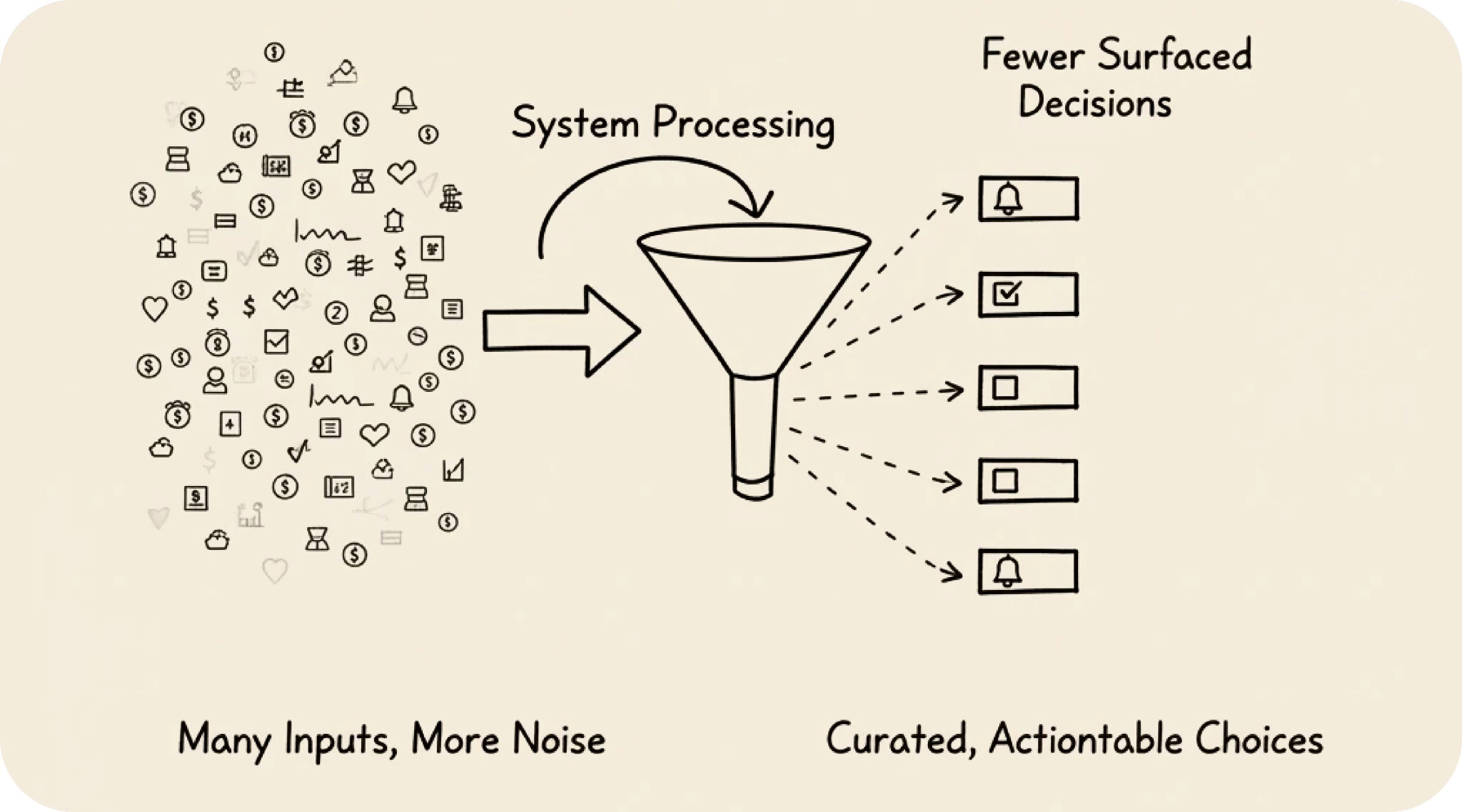
MORE SIGNALS → FEWER SURFACED DECISIONS → HIGHER TRUST

Business & Technical Realities

Business & Technical Realities

As an exploratory system design, Finnovó operated under real constraints:

• No access to real banking APIs

• No historical user trust or training data

• AI outputs could be uncertain or wrong

These constraints defined the system. The interface is a consequence of them.

Validation & What Would Be Tested in Production

Validation & What Would Be Tested in Production

What This System Was Not Validated On

This was an exploratory system — not a live fintech product.

• No real banking APIs

• No long-term user data

• No financial outcome claims

These aspects were validated through design reasoning, simulated flows, and behavioral modeling:

What Could Be Validated Pre-Production

System Predictability

• The system behaves consistently across similar failure scenarios

  • The system behaves consistently across similar failure scenarios

• No hidden escalation paths or surprise automation

  • No hidden escalation paths or surprise automation

• Overrides & breaches guarantee traceable failures

  • Overrides & breaches guarantee traceable failures

Goal: Make system stress states transparent & understandable.

Emotional Safety Under Failure

• No punitive alerts after overspending

  • No punitive alerts after overspending

• No guilt-based copy or corrective pressure

  • No guilt-based copy or corrective pressure

• Recovery language remains neutral and forward-looking

  • Recovery language remains neutral and forward-looking

Goal: Prevent avoidance, shame-driven churn, or disengagement

Override & Disagreement Handling

• Overrides never trigger penalties or friction

  • Overrides never trigger penalties or friction

• Ignored recommendations quietly inform future guidance

  • Ignored recommendations quietly inform future guidance

• Disagreement strengthens, rather than weakens, trust

  • Disagreement strengthens, rather than weakens, trust

Goal: Trust through reversibility, not compliance

Decision Pressure Reduction

• Fewer surfaced decisions during high-noise moments

  • Fewer surfaced decisions during high-noise moments

• Suggestions framed as optional, deferrable & reversible spent

  • Suggestions framed as optional, deferrable & reversible spent

• Silence preserved when intervention adds no value

  • Silence preserved when intervention adds no value

Goal: Reduce cognitive load without reducing agency

The system remains stable when users aren’t.

What Would Only Be Validated in Production

What Would Only Be Validated in Production

If deployed with real users, validation would focus on:

• Long-term trust retention after repeated failure

  • Long-term trust retention after repeated failure

• Calibration of when to intervene vs remain silent

  • Calibration of when to intervene vs remain silent

• User understanding of AI uncertainty

  • User understanding of AI uncertainty

• Behavioral drift over time (habits, not events)

  • Behavioral drift over time (habits, not events)

These cannot be responsibly simulated

Success Criteria (If Deployed)

Success Criteria (If Deployed)

Finnovó would be considered successful if:

• Users return after mistakes

  • Users return after mistakes

• Overrides don’t cause disengagement

  • Overrides don’t cause disengagement

• Fewer alerts with higher relevance

  • Fewer alerts with higher relevance

• Stable trust despite imperfect predictions

  • Stable trust despite imperfect predictions

The system succeeds if users stay — even when it’s wrong.

Why This Validation Approach Matters

Most fintech products validate control. Finnovó was designed to validate resilience — separating what can be reasoned about safely from what must be earned through time and trust.

This avoids over-claiming intelligence and instead earns credibility through restraint.

What we chose to optimize for

What we chose to optimize for

Primary Success Signals

Reduced Decision Friction

Fewer moments where users hesitate or abandon budgeting actions

Signals cognitive safety, not faster decision-making

Budget Boundary Adherence

Spending remains within suggested ranges over time, allowing natural deviations without triggering punitive feedback.

Healthy behavior, not discipline theater

Healthy override rate (not zero)

Users occasionally reject system suggestions while maintaining long-term engagement.

Trust without obedience

Recovery Speed After Failure

Time taken for users to re-engage after overspending or boundary breaches.

Emotional safety indicator

These signals were chosen over traditional ‘performance’ metrics.

Why This Project Matters

Why This Project Matters

Finnovó is not about budgeting.

Good UX is less about adding features — and more about deciding what not to surface, when, and why

Key Design Learnings

• Behavior-first design outperforms feature-first design Especially in financial contexts where fear and overload dominate.

  • Behavior-first design outperforms feature-first design Especially in financial contexts where fear and overload dominate.

• Motion is not decoration — it sets emotional pacing Micro-feedback reduced hesitation more effectively than static clarity.

  • Motion is not decoration — it sets emotional pacing Micro-feedback reduced hesitation more effectively than static clarity.

• AI is most useful when it reduces choice, not when it explains everything Contextual hints outperformed predictive recommendations.

  • AI is most useful when it reduces choice, not when it explains everything Contextual hints outperformed predictive recommendations.

What I Would Improve With Real Users

• Validate GenIndic language clarity with real financial stress scenarios

  • Validate GenIndic language clarity with real financial stress scenarios

• Test adaptive states triggered by spending behavior over time

  • Test adaptive states triggered by spending behavior over time

• Measure recovery speed after financial mistakes, not task completion

  • Measure recovery speed after financial mistakes, not task completion

• Personalize onboarding to reduce early cognitive load

  • Personalize onboarding to reduce early cognitive load

This project will evolve beyond a 2D interface into a system that explores how motion, spatial computing, and AI can make financial information feel less intimidating and more humane.

25th Dec 25'

25th Dec 25'

Iteration 01

Design Evolution

Design Evolution

Visibility vs Protection

Visibility vs Protection

Initial Assumption

Financial information should be immediately visible for convenience.

Challenge

Sensitive financial data should require intentional access. Friction can act as both a security and privacy layer.

Design Decision

Balance information was removed from the home screen and placed behind a deliberate access point.

Why This Changed

Why This Changed

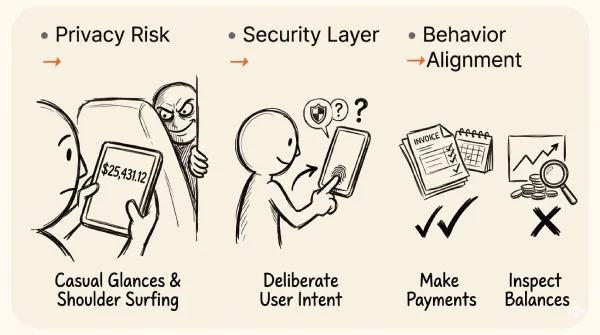
• Privacy Risk

  • Privacy Risk

Sensitive balances could be exposed through casual glances or shoulder surfing.

• Security Layer

  • Security Layer

Financial information should require deliberate user intent.

• Behavior Alignment

  • Behavior Alignment

Users open finance apps more frequently to make payments than to inspect balances.
A typical finance UX failure loop:
choice overload → emotional pressure → avoidance → abandonment

Resulting Home Screen Philosophy

Instead of:

Home = Information

Finnovó evolved toward:

Home = Action

The primary surface now prioritizes frequent user actions such as QR-based payments, while sensitive financial information remains accessible through intentional navigation.

Before

Immediate

Convenience

Monitoring

After

Protection

Action

Intentional

Immediate balance visibility

Intentional access + action-first home

Impact of the Change

• Reduced unintended exposure of financial data

• Required intentional access to sensitive information

• Better aligned with established fintech security practices

• Shifted the home screen from monitoring to action-taking

The home screen shifted from monitoring to action-taking.

The home screen shifted from monitoring to action-taking.

Design Review Insight

Design Review Insight

During a product critique, an important assumption was challenged:

During a product critique, an important assumption was challenged:

should sensitive financial information be immediately visible?

The feedback highlighted that, in fintech, a small amount of friction is intentional—it protects user privacy, reinforces security & ensures sensitive information is accessed deliberately rather than incidentally.

Visual System Evolution

Visual System Evolution

Aligning the Interface with Context

Months after the initial concept, I revisited Finnovó’s visual language while reviewing contemporary banking and finance products.

One consistent pattern emerged: financial interfaces adapt their visual tone to the user’s environment, using appearance not only for aesthetics, but also for comfort, readability, and long-term usability.

This prompted a redesign of Finnovó’s color system.

Immediate balance visibility

Intentional access + action-first home

What Changed?

Before

Single visual theme

Single visual theme

Beige interface

Beige interface

Static palette

Static palette

Functional consistency

Functional consistency

After

Adaptive light & dark system

Adaptive light & dark system

Warm beige (Light) + Deep green (Dark)

Warm beige (Light) + Deep green (Dark)

Context-aware appearance

Context-aware appearance

Functional + environmental consistency

Functional + environmental consistency

Dhanyawad

Dhanyawad

Design isn't about Aesthetics, it's about Storytelling, evoking emotions and driving actions